Showing posts with label silver coin. Show all posts

Sunday, February 28, 2016

Titanium Great White Shark Coin Available From the Pobjoy Mint

The Pobjoy Mint’s newest colorful titanium coin, issued on behalf of the British Virgin Islands government, features the powerful great white shark. In addition to the turquoise titanium $5 coin, an Uncirculated copper-nickel dollar and a Proof .925 fine silver $5 coin with the design are also available. 
The Great White Shark is getting the Titanium treatment from the Pobjoy Mint.
The great white shark (Carcharodon carcharias) is a species of large shark that can be found in the coastal waters of all the major oceans. Great white sharks are estimated to live as long as 70 years or more. The great white shark has no natural predators other than the orca and is one of the primary predators of marine mammals.
A great white has a white underside and a gray dorsal area. This coloration makes the shark difficult for prey to spot, because it breaks up the shark’s outline when seen from the side. From above, the darker shade blends with the sea, and from below, the shark’s silhouette against the sunlight is minimized.
The reverse of the coins shows an underwater scene with a central image of a great white shark. The obverses carry an effigy of Queen Elizabeth II exclusive to the Pobjoy Mint. 
Titanium is exceptionally difficult to strike and, because of the way the colored titanium reacts when striking, no titanium coin is exactly like another. A lined effect also present on the coins is unique to this metal.
COIN SPECIFICATIONS:
  • PURITY - .990 Fine Titanium
  • WEIGHT - Coin Weight 10 grams
  • MEASUREMENTS - 36.1 millimeters in diameter.
  • MINTAGE: limit of 5,000 pieces

Also Available are Copper Nickel and Silver Proof Versions - The Uncirculated copper-nickel dollar and Proof silver $10 coin each weigh 28.28 grams and measure 38.6 millimeters in diameter. The $1 coin has unlimited mintage and retails for $16.95. The $10 coin is limited to a mintage of 10,000 pieces and retails for $65.

Sunday, June 10, 2012

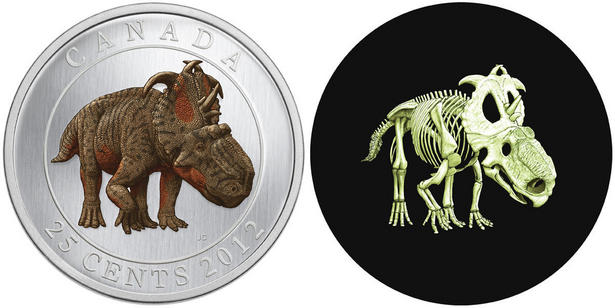
DINOSAUR GLOW IN THE DARK Pachyrhinosaurus Lakustai 25c Canada 2012


The Mint has created its first glow-in-the-dark coin, a quarter featuring a dinosaur discovered near Grand Prairie, Alta. in 1973.

In the light, the quarter features the Pachyrhinosaurus lakustai dinosaur, named after Al Lakusta, the man who stumbled on its bones in the Pipestone Creek bonebed.

When the lights go off, the dinosaur’s glowing skeleton is revealed.

The Mint only made 25,000 of these photoluminescent coins. It plans to release three more glow-in-the-dark coins featuring prehistoric creatures.

Apparently, the glowing effect won’t wear off.

While the quarters have a face value of 25 cents, they will be on sale online and at Canada Post locations for $29.95.

The Pachyrhinosaurus lakustai dinosaur coin is the first in a 4-coin Prehistoric Creature glow-in-the-dark (photo-luminescent) series! Turn off the lights and discover the Pachyrhinosaurus’s glowing skeleton! Designs approved by the Royal Tyrrell Museum of Palaeontology.

Pachyrhinosaurus lakustai

The frst Pachyrhinosaurus was unearthed and named by C.M. Sternberg in 1946, from the St. Mary Formation of Southwestern Alberta. Sternberg later described the specimen as Pachyrhinosaurus canadensis in 1950.

Pachyrhinosaurus was an ornithischian dinosaur, belonging to the larger group of ceratopsians, (horned, herbivorous dinosaurs). It lived in the Late Cretaceous of North America, about 72-68 million years ago.
Pachyrhinosaurus was a fairly large animal, like the present day rhinoceros, reaching up to 23 feet in length. As its name suggests, it had a thick (pachy) bony knob on its nose (rhino) rather than a horn. Its relatively broad skull had a short crest or frill on the back.

Al Lakusta, a Grande Prairie science teacher found the bonebed along Pipestone Creek in 1973. The bonebed has extreme signi cance because of its density of disarticulated skeletons. It contains up to 100 bones per square meter. 3500 bones, and over 20 skulls or partial skulls have been collected from the site.